
EV Battery Cell Holder Mould Injection Molding Key Points – A 21-Drop Hot Runner Case Study
2026-06-07 | Company News
In EV battery cell holder mould injection molding, the hardest challenge is often not the part design — but how to stably fill a "long and thin" product. Recently, JunSun Mould completed a representative project: an EV battery long thin cell holder with a length of over 1200mm and wall thickness of just 1.2mm, made of ABS+PC (flame-retardant grade, poor flowability),The solution was a 21-drop hot runner system. This article walks through the key technical points.
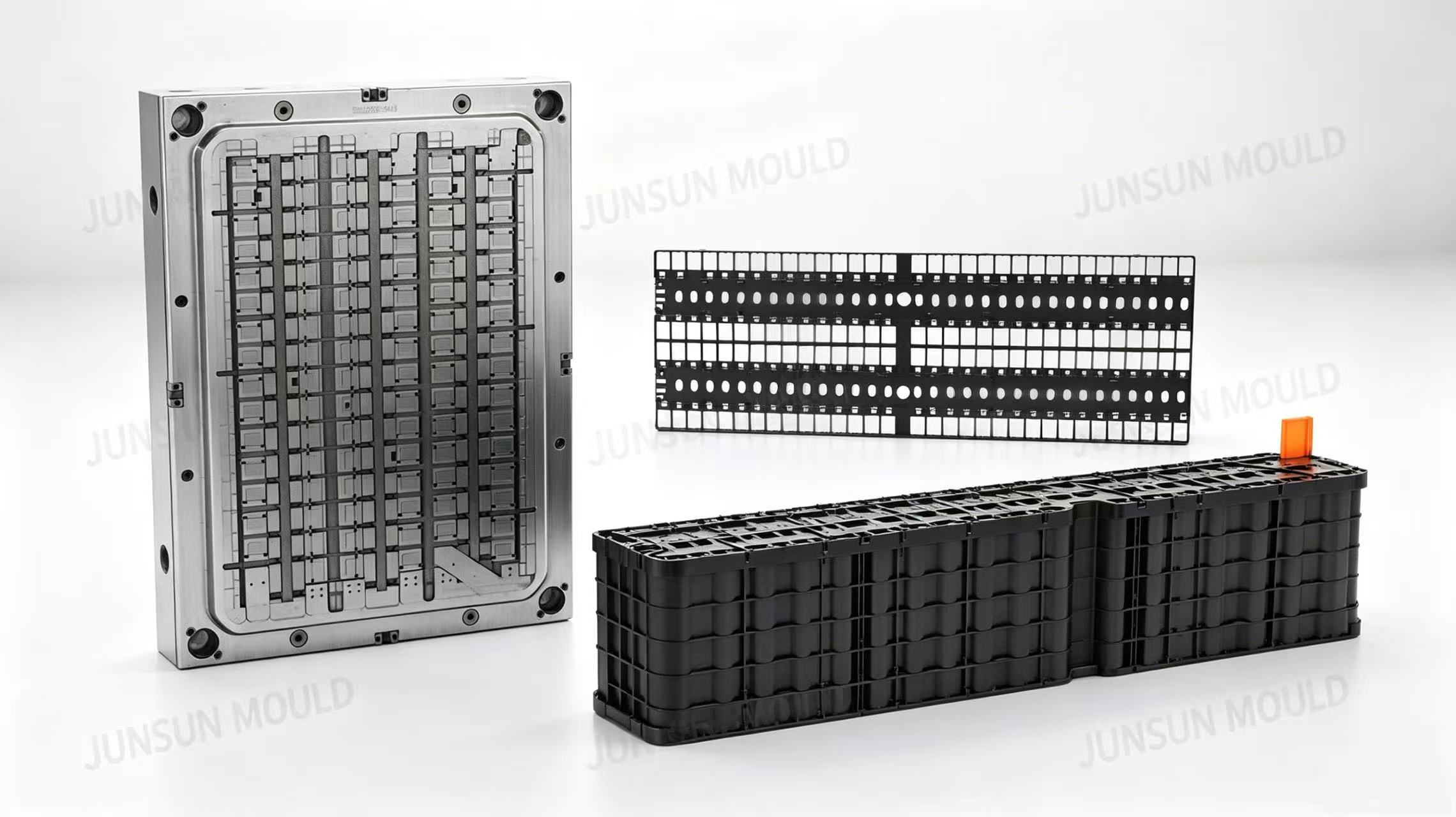
1. Three Key Points for EV Battery Cell Holder Injection Molding
For EV battery cell holder mould design and injection molding, three core key points need priority attention:
| Key Point | Description |
|---|---|
| Fill balance | For long thin parts, the melt must reach the end of the cavity simultaneously — otherwise short shots or trapped air occur |
| Warpage control | Cell holders require high dimensional precision (typically ±0.05mm). Poor cooling design causes deformation |
| Multi-cavity consistency | To maximize productivity, EV cell holder moulds are often 8, 16, or even 32 cavities — cavity-to-cavity consistency is critical |
JunSun Mould has a mature design methodology for all three key points.
2. Project Background: Long Thin EV Battery Cell Holder
The product is a long strip cell holder for an EV battery module. Customer requirements:
-
Length: 320mm
-
Wall thickness: 1.0mm (0.8mm at thinnest)
-
Material: ABS+PC (flame-retardant grade, UL94 V-0)
-
Cavities: 16
-
Dimensional tolerance: ±0.05mm
Core challenges:
| Challenge | Description |
|---|---|
| Thin wall + long flow length | At 1.0mm thickness, flow resistance is extremely high; conventional gate designs cause short shots at the far end |
| Poor material flowability | ABS+PC with flame retardant has 30-40% lower MFI than standard ABS, making filling harder |
| 16-cavity balance | 16 cavities running together — cavity-to-cavity filling balance is a major challenge |
3. The Solution: 21-Drop Hot Runner System
To address these challenges, JunSun Mould's design team did not go with a conventional 2 or 4-drop solution. Instead, we implemented a 21-drop hot runner system.
Why 21 drops?
-
At 320mm length, single-side gating would make the flow path too long
-
We used a staggered, dual-side gating approach: 10-11 drops per side, 21 drops total
-
Drop spacing was kept at 30-40mm to ensure the melt front does not freeze at the far end
Hot runner specifications:
| Item | Selection |
|---|---|
| Brand | Taiwan / Imported (based on customer budget) |
| Nozzle type | Valve gate, each with independent timing control |
| Heating | Heater bands with independent thermocouples |
| Gate diameter | 1.2mm — balancing filling and gate vestige |
4. Moldflow Analysis: From Simulation to Validation
Before machining the mould, JunSun Mould ran a full Moldflow analysis.
Key findings:
-
Fill time: 21 drops filling simultaneously, fill time ≈ 1.8 seconds — much lower than 4.5 seconds with single-side gating
-
Injection pressure: Peak pressure kept under 120MPa, within machine limits
-
Weld line location: Adjusted gate timing to move weld lines to non-stress areas
-
Warpage: Predicted 0.12mm, within tolerance
Actual trial molding results closely matched the simulation — validating the 21-drop approach.
5. Why is ABS+PC a Common Material for EV Cell Holders?
ABS+PC is a common engineering plastic alloy, combining the toughness of ABS with the strength of PC. For EV cell holder applications, it has clear advantages — but also special considerations:
| Advantages | Considerations |
|---|---|
| Good impact resistance | Flame retardant additives significantly lower flowability |
| High heat deflection temperature | Thermally sensitive — degrades at high temperatures |
| Good dimensional stability | Requires strict temperature control and multiple gate points |
JunSun Mould's countermeasures:
-
Increase drop count to shorten flow length
-
Strictly control melt temperature and residence time
-
Use valve gates to reduce shear heating
6. Summary of Key Design Points for EV Cell Holder Moulds
Based on this 21-drop project experience, JunSun Mould summarizes several core design points for EV battery cell holder moulds:
-
More drops, not fewer
For thin-wall long parts, better to add more drops than to risk short shots. 21 drops may sound like a lot, but it's far cheaper than mould rework. -
Sequential valve gate timing is critical
Not all 21 valve gates open at once. Use staged opening: middle gates first, end gates later, to avoid trapped air. -
Balanced cooling system design
Cooling channels on long moulds must be evenly distributed along the length to avoid warpage from hot spots. -
Mold steel and polishing matter
To ensure smooth ABS+PC flow, all runner and cavity surfaces are mirror-polished to reduce flow resistance. -
Document every trial parameter
Create a complete process parameter sheet for each mould to enable repeatable mass production.
7. JunSun Mould's Positioning
JunSun Mould is a China Battery Housing Mould Supplier & Battery Cell Holder Mould Manufacturer focused exclusively on new energy battery structural components.
This 21-drop EV cell holder project is just one example from our portfolio. If you are developing similar thin-wall cell holders or battery housings, feel free to reach out with your drawings.
Contact Us:
-
Website: www.junsunplast.com
-
Email: mould@junsunplast.com
-
WhatsApp/WeChat: +86 152 05867586
As a top 5 boiler manufacturers in China, Linkjoint has plenty of accolades from our valued customers due to its sophisticated design, excellent quality, eco-friendly thermal solutions, state-of-the-art equipment and sustaining innovation. Some of latest information about our products and exhibitions we attended are shown as follows.
EV Battery Module Plastic Shell Mold Manufacturer
JunSun Mould specializes in high-quality plastic shell molds for EV battery modules. With proven experience supplying molds for brands like BYD, we deliver tailored solutions for your battery shell mold challenges. Contact us for expert mold design and manufacturing.
Achieving Remarkable Light Weight in Vegetable Crates: The JunSun Mould Advantage
As a leading light weight crate mould manufacturer - JunSun Mould provides comprehensive solutions for crate product design, mould design and mould manufacturing.
Why need mold-flow analysis before mould designing?
Before the current mould design, mold-flow analysis is conducted to analyze the plastic parts themselves, and injection, pressure, and other analyses are performed on the plastic parts before designing the mould. The benefits of conducting mold-flow analysis for moulds are as follows: